
Skip to content
EduHubAdda

Mapisa-Nqakula Section 174 Application Pretoria: Court Reserves Judgment for September 7
Kanjari BhattacharyyaApplicationForm

Mapisa-Nqakula Section 174 Application: Sept 7 Judgment

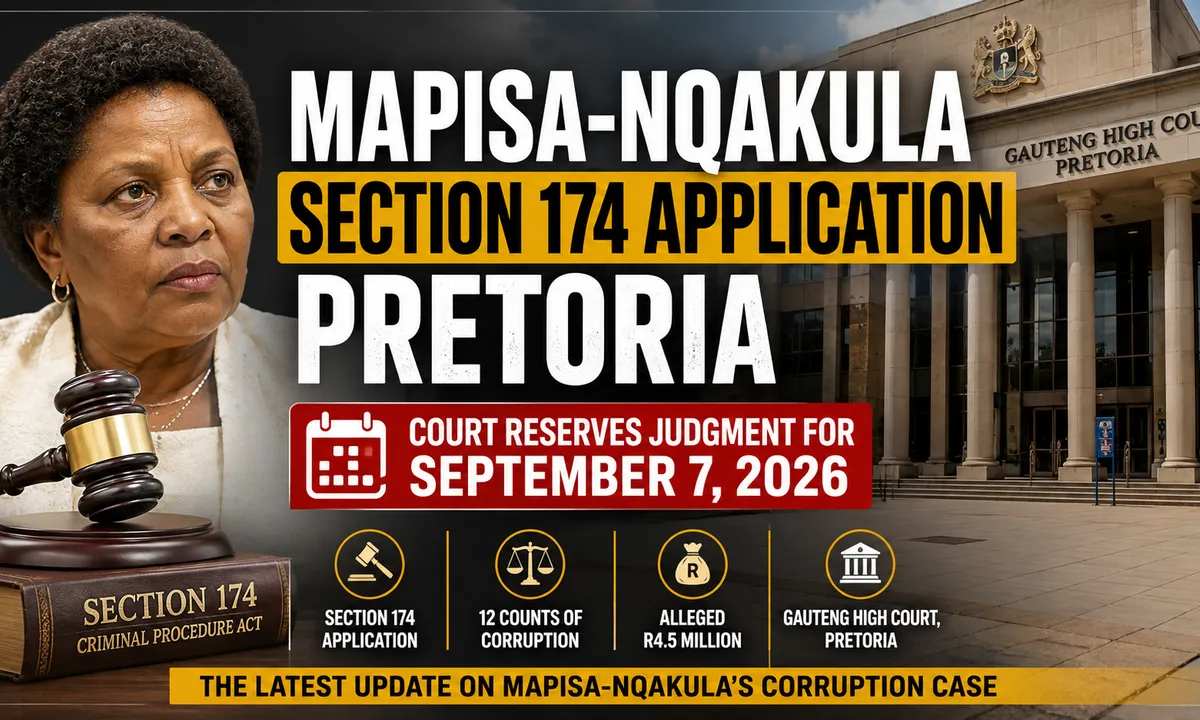
The Gauteng High Court in Pretoria has reserved judgment on Nosiviwe Mapisa-Nqakula’s Section 174 discharge application. The former National Assembly Speaker faces corruption and money laundering charges linked to alleged payments of about R4.5 million. Judgment is expected on September 7, 2026.

The Mapisa-Nqakula Section 174 application in Pretoria has become the latest major development in the corruption and money-laundering trial involving former National Assembly Speaker and former Defence Minister Nosiviwe Mapisa-Nqakula. The Gauteng High Court in Pretoria has reserved judgment on her application to be discharged from the case after the State closed its evidence.
The court is expected to deliver judgment on the application on September 7, 2026. The development follows extensive arguments from both sides about whether the State has presented enough evidence for Mapisa-Nqakula to be required to answer the charges.
Mapisa-Nqakula faces 12 counts of corruption and one count of money laundering. The State alleges that she solicited approximately R4.5 million in payments from defence contractor Nombasa Ntsondwa-Ndhlovu, with approximately R2.1 million allegedly received in cash. Mapisa-Nqakula has pleaded not guilty and denies the allegations.
This article explains the latest Mapisa-Nqakula Section 174 application, what Section 174 means, the arguments from the defence and prosecution, the charges she faces and what could happen after the court delivers its judgment.

ο»Ώ

Mapisa-Nqakula Section 174 Application – Latest Update

The latest proceedings took place in the Gauteng High Court in Pretoria, where Mapisa-Nqakula's defence argued that the State had failed to establish a sufficient case against her.
After the prosecution closed its case, the defence brought an application under Section 174 of the Criminal Procedure Act, asking the court to discharge Mapisa-Nqakula rather than require her to present a defence.
On August 31, the court heard arguments from both sides. The defence maintained that the evidence presented by the prosecution did not establish the necessary connection between Mapisa-Nqakula and the alleged corrupt payments.
The State opposed the application and argued that sufficient evidence exists for the case to continue.
Judgment has been reserved for September 7, 2026.

ο»Ώ

What Is a Section 174 Application?

A Section 174 application is a legal mechanism under South Africa's Criminal Procedure Act that allows an accused person to seek a discharge at the close of the prosecution's case.
In simple terms, once the State has finished presenting its evidence, the accused can argue that the prosecution has not presented sufficient evidence to justify requiring the accused to enter a defence.
If the court grants the application, the accused is discharged and the prosecution does not proceed to the defence stage.
If the application is dismissed, the criminal trial continues and the defence can present its case.
In Mapisa-Nqakula's matter, the defence is therefore asking the Pretoria High Court to end the proceedings against her at this stage rather than requiring her to answer the State's case.

ο»Ώ

Why Did Mapisa-Nqakula Apply for a Discharge?

The defence's central argument is that the State has not produced sufficient evidence directly establishing that Mapisa-Nqakula committed the alleged offences.
According to reporting on the August 31 proceedings, defence lawyer Siyabulela Mapoma SC argued that the State's case relied heavily on inferences and the testimony of the contractor who allegedly made the payments.
The defence questioned whether the prosecution had demonstrated the specific reason for the payments and argued that there was no direct evidence proving that Mapisa-Nqakula physically accepted the alleged cash payments.
The defence also challenged the interpretation of WhatsApp communications that the State presented as evidence.
The legal team argued that references to terms such as β€œimpepho”, β€œsnuff” and β€œpadkos” did not, on their own, establish that the messages referred to illicit payments.
These arguments form part of the defence's broader position that the State has not established a case strong enough to require Mapisa-Nqakula to enter the defence phase.

ο»Ώ

What Is the State's Argument?

The prosecution strongly opposes the Section 174 application.
State Advocate Emile van der Merwe argued that the State had presented sufficient evidence for the case to continue.
The prosecution maintains that the evidence goes beyond the testimony of a single witness.
The State has argued that the testimony of the contractor, Nombasa Ntsondwa-Ndhlovu, was supported by evidence from other witnesses. The prosecution has also argued that there was no obvious reason for the contractor to falsely implicate Mapisa-Nqakula.
The State further argues that evidence concerning payments, communications and financial transactions should be considered collectively rather than individually.
The prosecution has therefore asked the court to reject the Section 174 application and allow the trial to continue.

ο»Ώ

What Are the Charges Against Mapisa-Nqakula?

Mapisa-Nqakula faces 12 corruption charges and one count of money laundering.
The allegations relate to the period when she served as Minister of Defence and Military Veterans.
The State alleges that she solicited approximately R4.5 million from a defence contractor.
The prosecution alleges that around R2.1 million was received as cash payments.
Mapisa-Nqakula has denied the allegations and pleaded not guilty to the charges.
It is important to note that these are allegations made in the criminal proceedings and have not been established as facts simply because they have been presented by the prosecution.

ο»Ώ

Who Is Nombasa Ntsondwa-Ndhlovu?

Nombasa Ntsondwa-Ndhlovu is the defence contractor whose evidence is central to the State's case.
The State alleges that payments were made by Ntsondwa-Ndhlovu in connection with contracts involving the Department of Defence.
Her testimony has been an important part of the prosecution's evidence.
The defence, however, has challenged aspects of her evidence and questioned whether the State has sufficiently established the alleged connection between the payments and corrupt conduct.
The court will ultimately have to determine whether the evidence presented by the prosecution meets the legal threshold required at this stage of the proceedings.

ο»Ώ

Evidence Discussed in the Pretoria Court

The prosecution has relied on several categories of evidence during the trial.
These include:
Testimony from the defence contractor
Evidence from other witnesses
WhatsApp communications
Financial records
Evidence relating to cash payments
Information concerning renovations to Mapisa-Nqakula's Johannesburg home
The State has argued that the evidence should be considered as a whole.
During the recent Section 174 arguments, the prosecution referred to financial records and alleged cash payments made to builders working on renovations.
The State argued that available legitimate cash withdrawals from family bank accounts did not sufficiently explain the cash used for the renovations.
The defence has challenged the conclusions the prosecution seeks to draw from this evidence.

ο»Ώ

Why Is September 7 Important?

The date September 7, 2026, is significant because the Pretoria High Court is expected to deliver judgment on the Section 174 application on that date.
The ruling could determine whether the case proceeds to the next stage.
There are two broad possibilities.

If the Section 174 Application Is Granted

If the court grants the application, Mapisa-Nqakula would be discharged at the close of the State's case.
That would mean the prosecution would not proceed to require her to present a defence in the current trial.

If the Section 174 Application Is Dismissed

If the court rejects the application, the trial would continue.
The defence would then have the opportunity to present its case, which could include calling witnesses and potentially having Mapisa-Nqakula testify.
The court's ruling will therefore be an important milestone in the long-running case.

ο»Ώ

Timeline of the Mapisa-Nqakula Case

The case has developed over several years.

2016–2019: Period of Alleged Payments

The State's allegations concern payments allegedly made during the period associated with Mapisa-Nqakula's tenure as Defence Minister.

2024: Arrest and Political Resignation

Mapisa-Nqakula was arrested in April 2024 and subsequently stepped down as Speaker of Parliament.

2025: Trial Preparations

The National Prosecuting Authority said in November 2025 that the Gauteng High Court in Pretoria had postponed the matter to July 2026 for trial.

July–August 2026: Trial

The State presented its case and called witnesses during the trial.

August 2026: State Closes Its Case

After the prosecution closed its case, Mapisa-Nqakula's defence indicated that it would bring a Section 174 application.

August 31, 2026: Arguments Heard

The High Court in Pretoria heard arguments from both the defence and prosecution regarding the discharge application.

September 7, 2026: Judgment Expected

The court has reserved judgment on the Section 174 application for September 7.

ο»Ώ

What Happens After the Section 174 Judgment?

The next step depends entirely on the court's ruling.
If the application succeeds, the current prosecution case would end with Mapisa-Nqakula's discharge.
If the application fails, the trial could move into the defence stage.
The defence may then decide which witnesses to call and what evidence to present.
The outcome therefore has significant implications for the future direction of the proceedings.

ο»Ώ

Why the Case Is Significant

The Mapisa-Nqakula case has attracted significant public attention because of her former positions in South African public life.
Before leaving Parliament, Mapisa-Nqakula served as Speaker of the National Assembly. She had also served as Minister of Defence and Military Veterans.
The allegations concern the period in which she held a senior government position and involve alleged interactions with a contractor doing business with the State.
The case therefore forms part of broader public scrutiny of alleged corruption involving government officials and public procurement.
At the same time, the legal process requires the allegations to be tested in court, and Mapisa-Nqakula remains entitled to the presumption of innocence unless proven guilty.

ο»Ώ

Mapisa-Nqakula's Position

Mapisa-Nqakula has consistently denied the corruption and money-laundering allegations.
Her current legal strategy focuses on the argument that the State has not presented enough evidence to require her to enter a defence.
The Section 174 application is therefore an attempt to have the case discharged before the defence stage begins.
Her legal team's arguments challenge the reliability and interpretation of key elements of the prosecution's evidence, including alleged payments, communications and financial records.

ο»Ώ

State's Position

The State maintains that there is enough evidence to continue the prosecution.
The prosecution argues that the evidence should be assessed collectively and that the testimony of the key contractor is supported by other evidence and witnesses.
The State has therefore asked the court to reject the Section 174 application and allow the trial to proceed.

ο»Ώ

Final Words

The Mapisa-Nqakula Section 174 application in Pretoria is now at a crucial stage. After the State closed its case, the former Speaker's defence asked the Gauteng High Court to discharge her, arguing that the prosecution had failed to establish sufficient evidence connecting her to the alleged corruption and money laundering.
The State strongly opposes the application and maintains that its evidence is sufficient for the matter to continue. The prosecution has pointed to testimony from the key contractor, evidence from other witnesses, communications and financial information as part of its case.
The Pretoria High Court has reserved judgment for September 7, 2026. The ruling will determine whether the case ends at the current stage or proceeds into the defence phase.
Regardless of the outcome, the Section 174 decision represents an important moment in one of South Africa's closely watched corruption cases involving a former senior government official.
For readers following the Mapisa-Nqakula trial, Section 174 application, Pretoria High Court proceedings and corruption case, the September 7 judgment date will be the next major development.
All allegations should continue to be understood in the context of the ongoing court proceedings. Mapisa-Nqakula has pleaded not guilty, and the allegations against her have not been established as fact merely because they have been presented by the prosecution.

Frequently asked questions

  • What is the Mapisa-Nqakula Section 174 application?

    The State's allegations concern payments allegedly made during the period associated with Mapisa-Nqakula's tenure as Defence Minister.

  • Where is the Mapisa-Nqakula case being heard?

    The case is being heard in the Gauteng High Court in Pretoria.

  • When will judgment be delivered?

    udgment on the Section 174 application has been reserved for September 7, 2026.

  • What charges does Mapisa-Nqakula face?

    She faces 12 counts of corruption and one count of money laundering.

  • How much money is involved in the allegations?

    The State alleges that approximately R4.5 million was solicited, with around R2.1 million allegedly received in cash.

  • Does Mapisa-Nqakula admit to the allegations?

    No. She has pleaded not guilty and denies the allegations.

  • What happens if the Section 174 application is granted?

    Mapisa-Nqakula would be discharged at the close of the State's case, meaning the current trial would not proceed to the defence stage

  • What happens if the application is rejected?

    The trial would continue, with the defence expected to present its case.

  • Why is the Section 174 application important?

    It could determine whether the prosecution has presented enough evidence for the trial to continue or whether Mapisa-Nqakula should be discharged before presenting a defence.

Comments

The thread is quiet
If something in the piece stuck with you, leave the first note below.

Join the conversation

A short response is enough. We’ll review it before it appears on the site.

Kept for moderation. Email stays private.