Skip to content
EduHubAdda

RTI Application Form PDF Download 2026: How to Apply Online, Download Form & Complete Filing Process
Amit SharmaApplicationForm

RTI Application Form PDF Download 2026: Apply Online

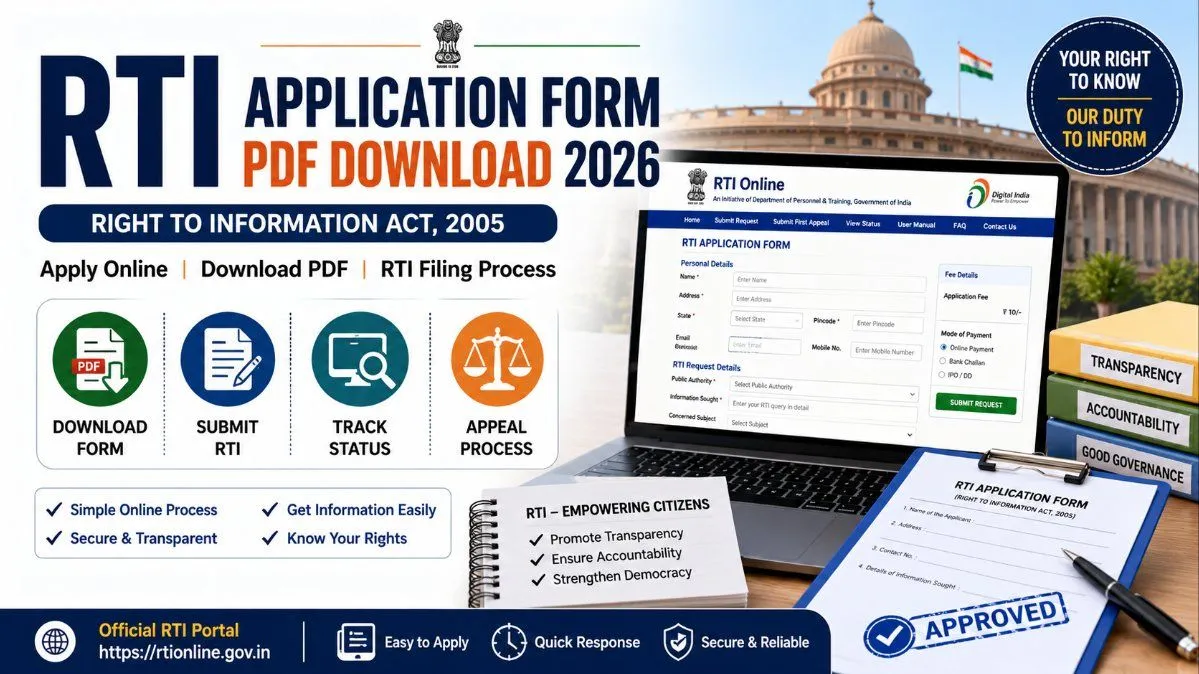
Looking to download the RTI Application Form PDF 2026? This complete guide explains how to apply online, download the form, pay the application fee, and file an RTI request under the Right to Information Act, 2005.

The Right to Information (RTI) Act, 2005 empowers every Indian citizen to seek information from public authorities, promoting transparency and accountability in government functioning. Whether you want information related to government schemes, recruitment, public records, or administrative decisions, filing an RTI application is one of the easiest legal ways to obtain it.
If you're looking for the RTI Application Form PDF Download 2026, you've come to the right place. In this guide, we'll explain how to download the RTI application form, apply online or offline, check the application fee, required documents, response timeline, and other important details.

RTI Application Form PDF Download 2026: Overview

Particulars
Details
Form Name
RTI Application Form
Act
Right to Information Act, 2005
Purpose
Seeking information from Public Authorities
Application Mode
Online & Offline
Beneficiaries
Indian Citizens
Official RTI Portal
https://rtionline.gov.in
Response Time
Normally within 30 days
Application Fee
β‚Ή10 (Generally)

What is an RTI Application?

The Right to Information (RTI) Act, 2005 allows Indian citizens to request information from Central and State Government departments, ministries, public sector undertakings, local bodies, and other public authorities.
Under the RTI Act, every public authority is required to provide the requested information within the prescribed time limit unless it falls under the exemptions specified in the Act.
The RTI Act helps improve transparency, accountability, and good governance.

Who Can Apply for RTI?

Only Indian citizens are eligible to file an RTI application.
Applicants can seek information from:
Central Government Departments
State Government Departments
Municipal Corporations
Panchayats
Government Universities
Government Schools
Public Sector Undertakings (PSUs)
Government Boards
Statutory Authorities

RTI Application Fee

The standard application fee for filing an RTI request is generally:
Category
Fee
General Applicants
β‚Ή10
Below Poverty Line (BPL)
No Fee (Proof Required)
Additional charges may apply for:
Photocopies
Printed documents
CDs/DVDs
Maps
Large records
The concerned public authority informs the applicant if any additional fee is payable.

Documents Required

Applicants generally need the following:
Applicant's Name
Complete Postal Address
Mobile Number (Optional)
Email ID (Optional)
Identity Proof (Only if specifically required)
BPL Certificate (If claiming fee exemption)
No specific reason is required for filing an RTI application.

How to Download RTI Application Form PDF 2026

Candidates can download the RTI application form by following these simple steps.
Step
Action
Step 1
Visit the official RTI Online Portal or your State RTI website.
Step 2
Navigate to the RTI Forms or Downloads section.
Step 3
Click on RTI Application Form PDF.
Step 4
Download the application form.
Step 5
Print the form and fill in all required details clearly.

How to File an RTI Application Online

The Government of India provides an online facility for filing RTI applications.

Online Application Process

Step
Action
Step 1
Visit the official RTI Online Portal.
Step 2
Click on Submit Request.
Step 3
Accept the guidelines displayed on the screen.
Step 4
Select the concerned Ministry or Department.
Step 5
Fill in your personal details.
Step 6
Enter your RTI query clearly.
Step 7
Upload supporting documents (if required).
Step 8
Pay the application fee online.
Step 9
Submit the application and save the registration number.

How to Submit an RTI Application Offline

Applicants can also file an RTI application offline.
The process includes:
Download the RTI application form.
Fill in the required details.
Attach the application fee through the prescribed mode.
Submit it to the Public Information Officer (PIO) of the concerned department.
Applicants should keep a copy of the submitted application for future reference.

What Information Can Be Requested Under RTI?

Applicants may seek information related to:
Government schemes
Recruitment processes
Examination records
Tender details
Budget allocation
Public expenditure
Official records
File movement
Government decisions
Rules and regulations
The requested information should already exist in official records.
## Information That Cannot Be Sought Under RTI
Certain information is exempt under Section 8 of the RTI Act.
Examples include:
National security matters
Personal information affecting privacy
Trade secrets
Cabinet papers (subject to provisions)
Intelligence agency records
Information prohibited by court orders
Applicants should ensure that their request complies with the provisions of the RTI Act.

RTI Response Timeline

The Public Information Officer (PIO) generally provides the requested information:
Situation
Time Limit
Normal RTI Application
Within 30 Days
Life or Liberty Cases
Within 48 Hours
RTI through Assistant PIO
Within 35 Days
If the information is denied or delayed without valid reasons, applicants may file a first appeal.

Benefits of Filing an RTI Application

The RTI Act helps citizens:
Promote transparency
Ensure accountability
Access government records
Monitor public spending
Strengthen democratic participation
Reduce corruption
It remains one of India's most significant transparency laws.

Final Words

The RTI Application Form PDF Download 2026 enables citizens to exercise their legal right to access information held by public authorities. Whether you choose to apply online or offline, filing an RTI application is a straightforward process that promotes transparency and accountability in governance.
Before submitting your request, ensure that your application is clear, concise, and directed to the appropriate Public Information Officer. Applicants should also refer to the official RTI portal or their respective State Government website for the latest updates regarding application procedures, fees, and appeal mechanisms.
Disclaimer: RTI application procedures, fees, and designated public authorities may vary between the Central Government and individual State Governments. Applicants should always verify the latest guidelines on the official RTI portal or the concerned government department before submitting an application.

Frequently Asked Questions FAQs

Q1. Who can file an RTI application?
Answer: Any Indian citizen can file an RTI application under the Right to Information Act, 2005.
Q2. What is the RTI application fee?
Answer: The standard application fee is generally β‚Ή10, while BPL applicants are exempt from paying the fee upon providing valid proof.
Q3. Can I file an RTI application online?
Answer: Yes. RTI applications can be filed online through the official RTI Online Portal for Central Government public authorities.
Q4. Is any reason required for filing an RTI?
Answer: No. Applicants are not required to provide any reason for seeking information under the RTI Act.
Q5. How long does it take to receive a reply?
Answer: Public authorities generally respond within 30 days from the date of receiving the application.
Q6. Can I download the RTI application form in PDF format?
Answer: Yes. The RTI application form can be downloaded from the official RTI portal or the respective State Government RTI websites.
Q7. What happens if I don't receive a reply?
Answer: If no reply is received within the prescribed time limit, you may file a First Appeal under the RTI Act.
Q8. Can I seek personal information about another individual?
Answer: Generally, personal information that has no relation to public activity or would invade an individual's privacy is exempt from disclosure under the RTI Act.

Frequently asked questions

  • What is an RTI Application?

    The **Right to Information (RTI) Act, 2005** allows Indian citizens to request information from Central and State Government departments, ministries, public sector undertakings, local bodies, and other public authorities. Under the RTI Act, every public authority is required to provide the requested information within the prescribed time limit unless it falls under the exemptions specified in the Act. The RTI Act helps improve transparency, accountability, and good governance.

  • Who Can Apply for RTI?

    Only Indian citizens are eligible to file an RTI application. Applicants can seek information from: * Central Government Departments * State Government Departments * Municipal Corporations * Panchayats * Government Universities * Government Schools * Public Sector Undertakings (PSUs) * Government Boards * Statutory Authorities

  • What Information Can Be Requested Under RTI?

    Applicants may seek information related to: * Government schemes * Recruitment processes * Examination records * Tender details * Budget allocation * Public expenditure * Official records * File movement * Government decisions * Rules and regulations The requested information should already exist in official records. * ## Information That Cannot Be Sought Under RTI Certain information is exempt under Section 8 of the RTI Act. Examples include: * National security matters * Personal information affecting privacy * Trade secrets * Cabinet papers (subject to provisions) * Intelligence agency records * Information prohibited by court orders Applicants should ensure that their request complies with the provisions of the RTI Act.

  • Q1. Who can file an RTI application?

    **Answer:** Any Indian citizen can file an RTI application under the Right to Information Act, 2005.

  • Q2. What is the RTI application fee?

    **Answer:** The standard application fee is generally **β‚Ή10**, while BPL applicants are exempt from paying the fee upon providing valid proof.

  • Q3. Can I file an RTI application online?

    **Answer:** Yes. RTI applications can be filed online through the official RTI Online Portal for Central Government public authorities.

  • Q4. Is any reason required for filing an RTI?

    **Answer:** No. Applicants are not required to provide any reason for seeking information under the RTI Act.

  • Q5. How long does it take to receive a reply?

    **Answer:** Public authorities generally respond within **30 days** from the date of receiving the application.

  • Q6. Can I download the RTI application form in PDF format?

    **Answer:** Yes. The RTI application form can be downloaded from the official RTI portal or the respective State Government RTI websites.

  • Q7. What happens if I don't receive a reply?

    **Answer:** If no reply is received within the prescribed time limit, you may file a First Appeal under the RTI Act.

  • Q8. Can I seek personal information about another individual?

    **Answer:** Generally, personal information that has no relation to public activity or would invade an individual's privacy is exempt from disclosure under the RTI Act.

Comments

The thread is quiet
If something in the piece stuck with you, leave the first note below.

Join the conversation

A short response is enough. We’ll review it before it appears on the site.

Kept for moderation. Email stays private.